

Three Infrastructure Projects, Three Governance Systems
What HS1, HS2, and Heathrow Terminal 2 reveal about ownership, authority, and the handling of risk

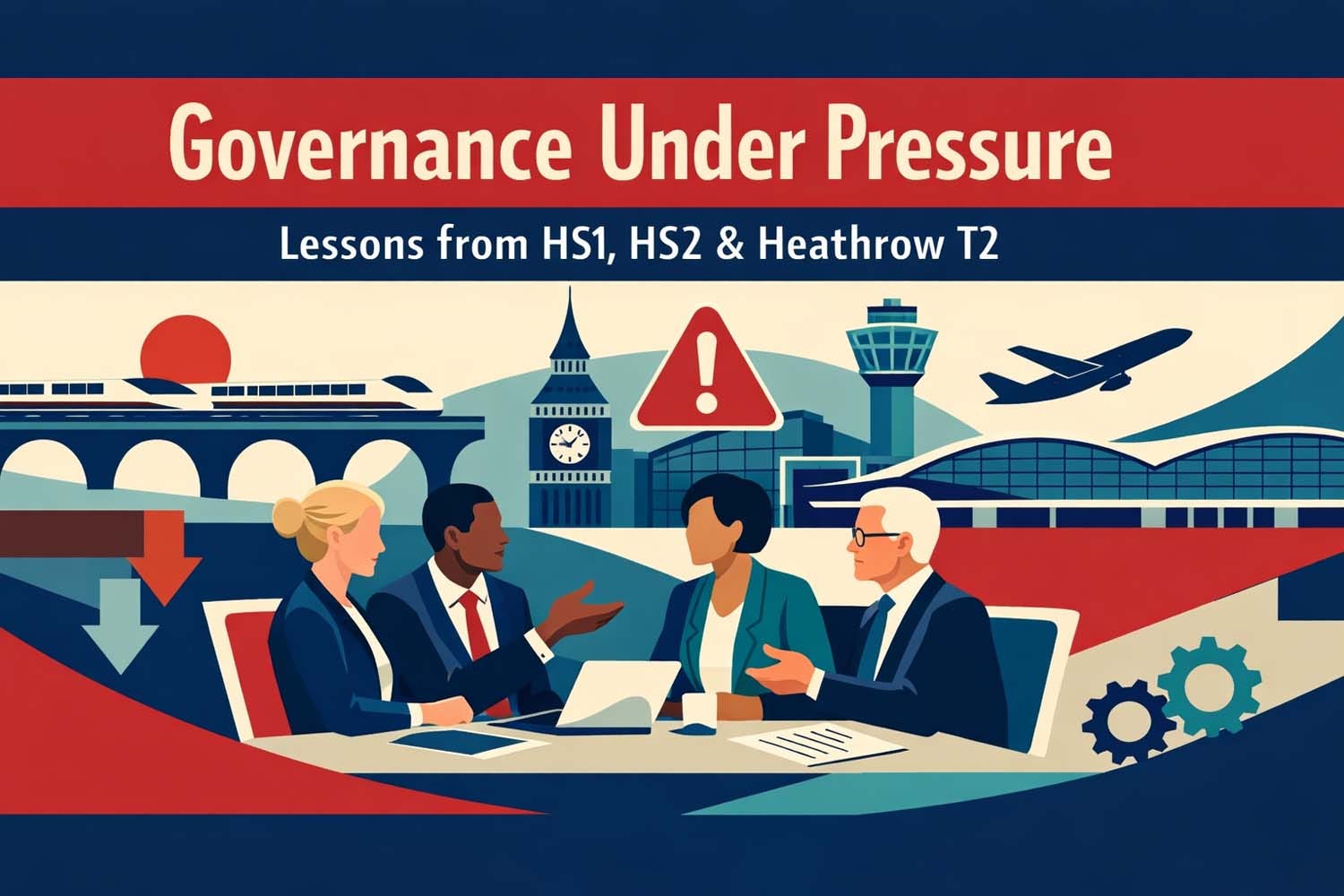
1. How to Read This Case
These three projects are often grouped together as examples of Britain’s struggle to deliver major infrastructure. That reading is understandable, but it obscures more than it explains.
Viewed through a systems lens, the comparison is not about national capability, engineering competence, or even political will. It is about how different governance systems behave under pressure, and what they predictably produce.
All three projects were complex. All were politically visible. All involved world-class engineering and substantial public scrutiny. Yet their trajectories diverged sharply.
This case warrants attention because it challenges a common assumption among senior leaders. That assumption is that delivery outcomes are primarily a function of project scale, ambition, or technical difficulty. In practice, outcomes track something else more closely: where ownership sits, how authority is distributed, and what the system does when plans collide with reality.
There is a temptation to read HS2 as a uniquely British failure, Heathrow Terminal 2 as an unusually well-run exception, and HS1 as a historical anomaly. That framing reassures rather than informs. It allows each case to be dismissed as special.
This Deep Dive takes a different approach. It treats each project as a distinct governance system, with its own incentives, time horizons, and failure modes. The aim is not to praise or condemn, but to understand how each system behaved once pressure accumulated.
The reader is not invited to judge whether HS2 should have existed, or whether Terminal 2 represents a model that can be replicated wholesale. Those questions tend to collapse into advocacy.
Instead, the focus is on mechanism. How authority was exercised. How risk was managed or displaced. How decisions were delayed, delegated, or redefined. And how, at critical moments, each system chose to preserve reputation, optionality, or completion.
What follows should be read with restraint. Events appear only to illuminate dynamics. Individuals appear only as occupants of roles. Culture appears only as an outcome of structure and incentives.
The question to hold throughout is simple, but uncomfortable:
When delivery became difficult, what did each system protect first.
2. The System Under Examination
This Deep Dive examines three major UK infrastructure programmes that are often discussed together but were constituted very differently from the outset.
Each involved complex engineering, high public visibility, and long delivery horizons. The differences that mattered most were not technical. They sat in how each project was commissioned, governed, and constrained.
Heathrow Terminal 2 was a major terminal redevelopment commissioned by Heathrow Airport Limited. The airport was, and remains, the owner and operator of the asset. Terminal 2 was designed to replace outdated facilities and integrate directly into a live, safety-critical operating environment. Delay or failure would have imposed immediate operational, commercial, and reputational costs on the airport itself.
Following the experience of Terminal 5, Heathrow deliberately structured its contractual arrangements to reduce adversarial risk transfer. The airport and its principal contractors worked under frameworks that emphasised shared risk, early warning, and joint problem-solving. This was often described as partnership, but the more important feature was structural. Heathrow retained ownership of outcomes. Risk-sharing was real because the client could not externalise failure. Problems had to be resolved, not escalated indefinitely.
High Speed 1, originally known as the Channel Tunnel Rail Link, was a new high-speed railway built to connect London to the Channel Tunnel and the European rail network. It was conceived as a nationally strategic asset but was also part of an international system linking the UK to France and beyond.
HS1 began under a private finance model that later collapsed. What followed is central to its relevance here. The UK government intervened, took ownership, restructured delivery, and preserved the project’s core purpose. Completion mattered not only domestically but internationally. The Channel Tunnel already existed. Trains were already running. Failure to complete HS1 would have left the UK as the weak link in a functioning European corridor, with reputational consequences that could not be managed quietly or deferred.
That external pressure narrowed the system’s options. Retreat was harder than completion. When delivery arrangements failed, governance was reset rather than ambition reduced.
HS2 was commissioned as a new national high-speed rail network intended to relieve capacity constraints on the existing rail system and improve long-distance connectivity between London, the Midlands, and the North of England. It was sponsored by central government, overseen by the Department for Transport, funded through public expenditure, and delivered through an arm’s-length company, HS2 Ltd.
Unlike Heathrow or HS1 in its later phase, HS2 had no single operating owner during delivery. There was no live system that would fail visibly if the project slipped. Authority was concentrated at the centre, while responsibility for delivery sat elsewhere. Political exposure was high, but external obligation was limited. The project could be slowed, re-scoped, or truncated without immediately breaching an international commitment or disrupting an operating asset.
These starting conditions shaped what each system was optimised to protect.
Terminal 2 was optimised for operational continuity and completion. Authority sat close to delivery, and shared risk worked because consequences were unavoidable.
HS1 evolved toward optimisation for asset completion under external and reputational constraint. When the original model failed, the system absorbed short-term disorder to preserve long-term coherence.
HS2 was optimised for reputational and fiscal risk management within central government. Authority remained centralised. Decisions that would close political options were deferred. When pressure intensified, scope became the release valve.
Information flows reflected these priorities. In the Heathrow system, information existed to enable decisions. In HS1, information eventually enabled reset. In HS2, information flowed upward primarily to provide assurance and preserve optionality.
None of these systems was irrational. Each behaved consistently with its institutional design.
What differs is what those designs made likely once delivery became difficult.
3. Observed Dynamics
Ownership and time horizon
What emerges most clearly across these three cases is not a difference in technical competence, but a difference in constraint.
Each system operated under a dominant form of pressure that shaped behaviour once delivery became difficult.
At Heathrow Terminal 2, the dominant constraint was shared risk anchored in live operations. The airport owned the asset, operated the system it was modifying, and absorbed the consequences of delay directly. Risk-sharing was not an abstract principle but an operational fact. Problems could not be parked without cost. Escalation without decision carried its own penalty.
In the HS1 case, the dominant constraint was external obligation. The railway was not an isolated domestic project but part of an international corridor that already existed. The Channel Tunnel was operational. European partners were engaged. Failure to complete HS1 would have left the UK visibly disconnected from a functioning system. That external pressure narrowed the option set. When financing failed, governance was reset, but purpose was not.
HS2 operated under a different constraint altogether. Its defining feature was political optionality. The project was nationally significant but domestically bounded. It did not sit inside a live operating system, nor did it anchor an international commitment that made retreat reputationally unavoidable. Authority was centralised, but ownership of consequences was diffuse.
These constraints did not determine outcomes in advance, but they shaped what each system found easier to do under stress.
Where risk was shared and immediate, problems were resolved.
Where obligation was external and visible, purpose was preserved.
Where optionality remained politically available, ambition could be narrowed without immediate rupture.
The dynamics that follow should be read through this lens. They show how each system responded as plans met reality, and how governance design, rather than intent, determined the path taken.
The most consequential difference between the three cases lies in ownership.
At Heathrow, the client was unambiguous. The airport had a continuing obligation to operate safely and efficiently. Failure to complete Terminal 2 would have imposed immediate operational and reputational costs. That concentrated attention and shortened the feedback loop between decision and consequence.
This shaped behaviour throughout the system. When problems emerged, they had to be resolved. Escalation without decision was itself costly.
HS1 began without this clarity. Early reliance on private finance collapsed under strain. What matters is what happened next. The state intervened, took ownership, revised the plan, and proceeded. The purpose remained stable even as the delivery model changed.
HS2 never reached that point of consolidation. Ownership was diffuse. The Department for Transport sponsored the project but did not operate the asset. The Treasury controlled funding gates without owning outcomes. HS2 Ltd carried delivery responsibility without full authority over scope or specification.
Political time horizons dominated. As elections approached and fiscal pressure increased, the system’s tolerance for long-term commitment narrowed.
The result was not collapse, but truncation.
Authority and decision-making under pressure
In Terminal 2, authority sat close to delivery. Contracting arrangements encouraged collaboration, but more importantly, they allowed trade-offs to be made where the consequences were understood.
HS1 struggled early precisely because authority and risk were misaligned. Its recovery began when those were realigned, even at the cost of political discomfort.
HS2 illustrates the opposite pattern. Authority remained centralised even as complexity grew. Decisions that would lock in cost or close political options were repeatedly escalated. Each escalation slowed the system and increased exposure.
Oversight multiplied. Reviews reassured, but they did not resolve. The cadence of spending reviews and re-baselining exercises became the dominant rhythm of the programme.
This is a familiar dynamic in large organisations. Control is asserted through process rather than decision. Responsibility remains distributed. No single actor can trade cost, time, scope, and performance in the open.
Incentives and risk behaviour
In Heathrow’s system, solving problems carried upside. Delay carried downside. That alignment mattered more than any single contract form.
In HS1, once the state committed to completion, incentives shifted toward delivery. The revised timetable and budget created a frame within which progress could occur.
In HS2, incentives pulled in the opposite direction. As political risk increased, participants acted rationally to protect their own exposure. Risks were surfaced, transferred, or deferred. Ambiguity became safer than commitment.
This was not dysfunction. It was the system working as designed.
The handling of contradiction
The most revealing moment in the HS2 case comes late.
Throughout this period, the physical work advanced to a high standard. Tunnels were bored accurately. Viaducts were built to specification. The engineering did not fail.
What failed was fit.
Infrastructure was delivered to a design brief whose original rationale had steadily eroded. Rolling stock was specified for uninterrupted high-speed running that would no longer exist. Stations were planned for service patterns that had been quietly abandoned.
The system reached a point where it could no longer deliver what it had originally set out to achieve, yet could not unwind what it had already committed to.
The cancellation of the northern sections did not resolve that contradiction. It froze it.
Taken late in a political cycle, the decision reflected a system operating under short-term reputational pressure rather than long-term transport logic. More damaging still was the subsequent willingness to dispose of land acquired for the unused route.
That step converted a politically reversible decision into a structurally irreversible one. A pause became a permanent loss of optionality. Balance sheet presentation was preserved at the expense of future capacity.
At this point, momentum no longer substituted for purpose. It replaced it.
Activity continued because stopping was harder than proceeding. Control was asserted through process rather than decision. Responsibility remained diffuse. Each actor behaved rationally within their remit, yet no one retained stewardship of the system as a whole.
This is not an unfamiliar end state.
Conclusions
Read together, HS1, HS2, and Heathrow Terminal 2 do not tell a story of national decline. They tell a story about governance design and its consequences.
Terminal 2 demonstrates what happens when ownership, authority, and consequence sit together. Problems are addressed because they must be. Completion matters because the system bears the cost of delay.
HS1 demonstrates that even when a project falters badly, a system can recover if it is willing to revise its delivery model while holding purpose steady. That requires accepting short-term disorder to preserve long-term coherence.
HS2 demonstrates a different failure mode. Not collapse, but erosion. Not incompetence, but misalignment. The system protected optionality, reputation, and fiscal appearance until the point where the original purpose could no longer be delivered, and then narrowed ambition rather than reset governance.
What similar boards and executives are likely to misread is how early this pattern sets in. The warning signs are not dramatic. They appear as additional oversight, further review, and the reluctance to make decisions that close options.
Effort is commonly misapplied to reassurance rather than ownership. More control is added where clarity is needed. More process is introduced where authority is lacking.
The most unsettling feature of the HS2 case is not the cost or the cancellation. It is the willingness to destroy future option value to relieve present pressure. That move shortens the system’s time horizon and transfers cost to those who are not yet at the table.
The conditions for a different outcome are not technical. They are structural. Clear ownership. Stable purpose. Authority aligned with responsibility. And a willingness to absorb political discomfort in order to preserve long-term coherence.
None of these conditions is exotic.
What should give pause is how easily they are lost, and how rarely they are restored once pressure rises.
That pattern extends well beyond rail.