

Dyslexia
What if what we call a “disability” is actually a different kind of strength?

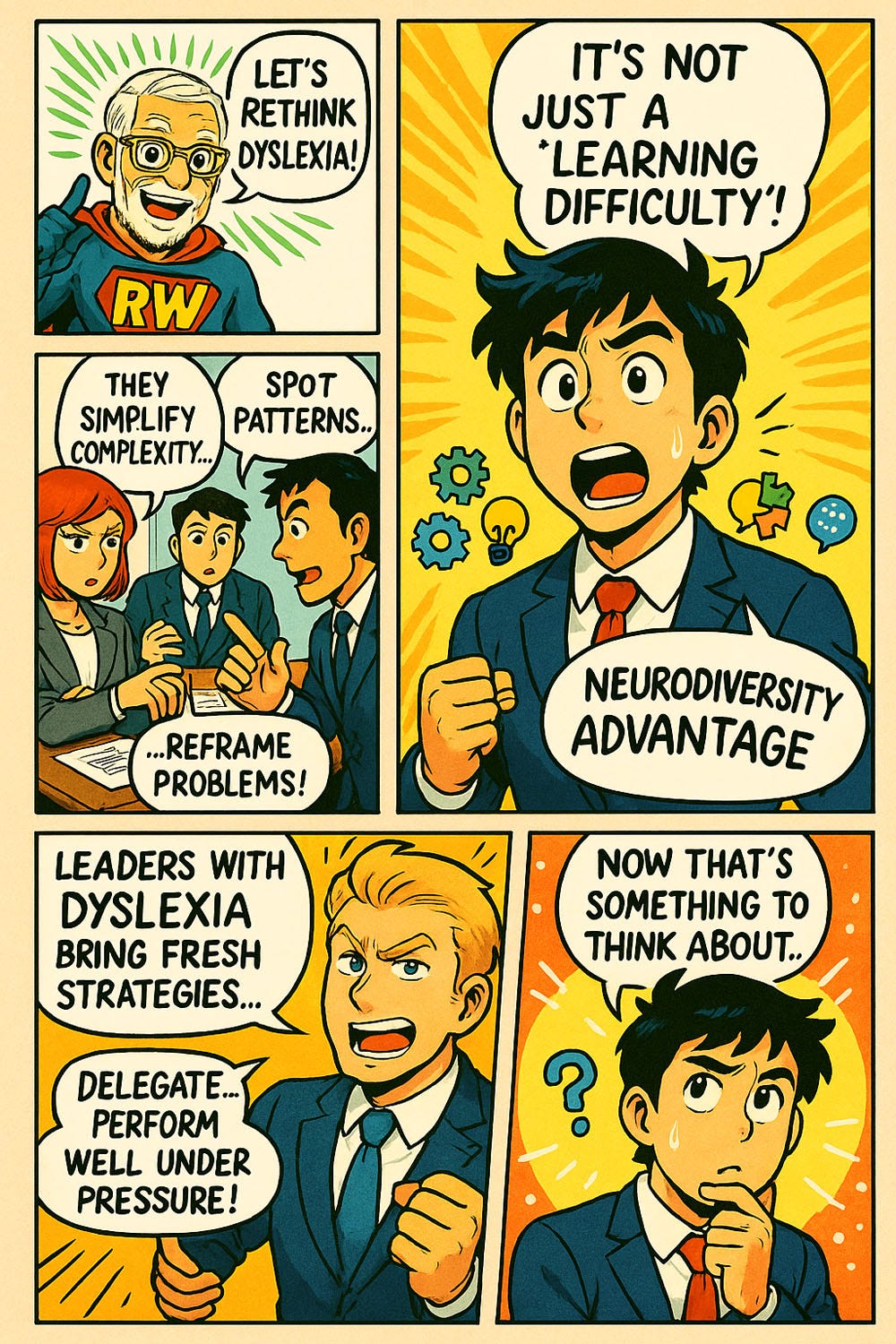
Dyslexia is typically seen through a narrow lens: as a reading difficulty, a learning challenge, a disadvantage to overcome.
But that perspective misses something important.
Dyslexia often comes with enhanced visual thinking, strong problem-solving skills, and the ability to connect ideas in novel ways. Many people with dyslexia process the world differently – and that difference can be a serious asset in business.
In fact, some of the most successful entrepreneurs and innovators are dyslexic. Not because they succeeded despite it, but because they learned to think differently – and that gave them an edge.
They simplify complexity. Spot patterns quickly. Reframe problems that others try to fix linearly.
This isn’t about tokenism. It’s about business outcomes.
Leaders with dyslexia often:
Bring fresh perspectives in strategy discussions.
Delegate well – focusing their time on where they deliver most value.
Perform under pressure, thanks to years of navigating uncertainty.
In a world where we need more innovation, more agility, and more inclusive thinking, neurodiversity is not a nice-to-have. It’s a leadership advantage.
If our systems only reward one kind of thinker, we risk filtering out the people who can help us rethink the system.
And that’s something worth reflecting on.