


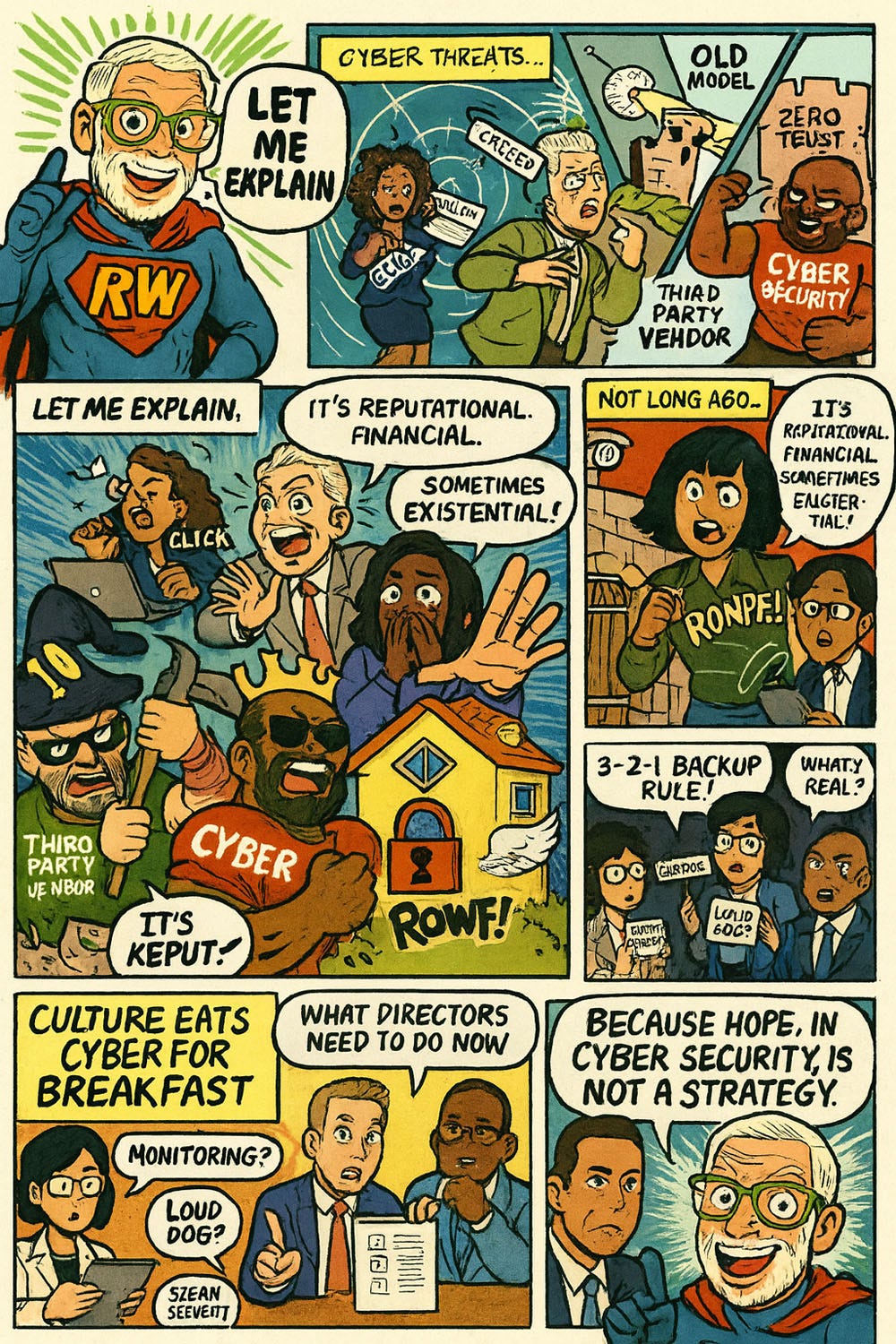
Cyber threats don’t knock.
They don’t announce themselves or follow the rules. They creep in—through a forgotten system update, a tired employee clicking a phishing link, or a compromised third-party vendor. And when they do, the fallout is rarely just technical. It's reputational. Financial. Operational. Sometimes, existential.
If you're a director or senior executive, here's the truth: cyber security is no longer just an IT problem. It's a governance priority.
And your organisation’s future may depend on how seriously you take it.
From Moats to Movement: Why the Old Model Doesn’t Work
Not long ago, cyber security looked a lot like castle defence. Build a strong wall. Dig a deep moat. Keep the bad guys out.
That worked—when data lived in a server room and employees worked on-site. But then came cloud computing. Remote work. SaaS everything. The walls vanished.
Enter the Zero Trust Model, first proposed in 2010 by analyst John Kindervag. It flipped conventional wisdom on its head.
Zero Trust says:
Never trust—always verify.
Every device and user is untrusted by default.
Access is limited to what’s absolutely necessary.
Monitoring is constant.
It’s not paranoia. It’s practical.
Because in a world without walls, you need a strategy that assumes attackers are already in the system—and builds resilience from the inside out.
Cyber Security Isn’t One Lock. It’s a Whole System.
Think of your business like a house. You wouldn’t just lock the front door and call it a day. You’d install motion sensors, security cameras, perhaps a big, loud dog.
Cyber security works the same way. The best defences are layered.
A strong strategy includes:
Infrastructure and Network Security – The perimeter guards
Application and Cloud Security – Guarding your digital crown jewels
Information Security – Ensuring confidentiality and data integrity
Employee Training – Turning your people into the first line of defence
Business Continuity and Disaster Recovery – Because when things go wrong, speed matters
Third-Party Risk Management – Your security is only as strong as your weakest vendor
It’s not about perfection. It’s about preparation.
Culture Eats Cyber for Breakfast
Here’s the part that doesn’t show up in technical reports: your culture makes or breaks your cyber resilience.
You can have the latest firewalls and encryption tools. But if your employees aren’t trained, if they’re afraid to ask questions, if they don’t know what phishing looks like—you’re exposed.
The most cyber-resilient organisations we’ve seen all have one thing in common:
They treat cyber security as everyone’s responsibility.
That means:
Talking about security openly—across teams and at board level
Rewarding people who report risks
Giving staff the confidence to pause and ask, "Is this safe?"
Making training relevant, regular, and engaging
Because in cyber security, silence is a risk.
The Plan B You Can’t Afford to Ignore
Even the best systems can fail. When they do, what matters most is how quickly you can bounce back.
That’s where the 3-2-1 Backup Rule comes in:
Keep three copies of your data
Store them on two different types of media
Keep one copy off-site (and preferably offline)
It’s a simple idea. But during a ransomware attack, this could be the difference between total loss and full recovery.
Ask yourself: if your systems went down right now, how long could your business stay afloat?
What Directors Need to Do Now
Let’s be honest. Many boards overestimate their organisation’s cyber readiness.
Surveys show most executives feel confident in their cyber spend, yet fewer than half describe their board’s understanding of cyber risk as proactive. That’s a dangerous gap.
The good news? It’s a fixable one.
Start with these actions:
Own the risk – Don’t delegate it blindly to IT
Ask better questions – About access control, incident response, and cultural maturity
Align with best practice – Frameworks like the Zero Trust Model and national cyber governance codes
Schedule regular reviews – Include cyber risk in board papers, risk registers, and strategic decisions
Invest in training – For staff, yes, but also for directors
Remember: you don’t need to be a cyber expert. But you do need to lead like it matters—because it does.
Final Thought
Cyber security isn’t about fear. It’s about leadership.
It’s about protecting the trust you’ve built with your customers, your shareholders, your employees. It’s about understanding that while you can’t eliminate risk, you can manage it—with foresight, clarity, and purpose.
So, the next time your board meets, ask this:
Are we truly prepared—or just hoping we are?
Because hope, in cyber security, is not a strategy.