

Carillion and the Stability Trap
How growth incentives, diffused authority, and reassurance systems combined to make collapse rational

Read the Deep Dive
1. How to Read This Lens
Carillion is often revisited as a story of corporate excess, weak ethics, or individual failure. Those readings are understandable. They are also incomplete. They locate causality in behaviour rather than in the system that made that behaviour both rational and repeatable.
This System Lens revisits Carillion because the conditions that governed its trajectory are not unusual. They remain present in many large, complex organisations operating under growth pressure, financial market expectations, and public sector dependency. What failed at Carillion was not the absence of governance, but the way governance interacted with incentives, authority, information, and constraint.
A common misreading is to treat Carillion as an outlier. The board was described as reckless. Executives were described as greedy. Auditors were described as negligent. These labels may describe outcomes, but they obscure mechanism. They imply that different people would have produced a different result, rather than recognising that the system strongly selected for the behaviour that occurred.
Another misreading is to assume that the presence of formal governance structures implies effective oversight. Carillion had committees, external auditors, risk processes, and compliance artefacts that met prevailing standards. The issue is not that these were absent, but that they functioned as reassurance mechanisms rather than as reality-testing mechanisms. The system rewarded continuity of confidence, not interrogation of assumptions.
A third misreading is to focus on accounting practices in isolation. Aggressive revenue recognition mattered, but not as a technical error. It mattered because it allowed risk to be displaced temporally and organisationally. It converted future uncertainty into present certainty, which then justified dividends, bonuses, and further growth. Accounting became a mechanism for stabilising narrative rather than reflecting underlying conditions.
The system under examination here is a listed commercial organisation operating at the intersection of capital markets and public service delivery. It combined private-sector growth incentives with quasi-public reliance and political sensitivity. This hybrid position created powerful boundary conditions. Failure was costly. Disclosure was risky. Continuity was rewarded.
Causality in this case sits primarily in four places:
Authority design, where responsibility for outcomes was formally clear but practically diffused.
Incentive alignment, where short-term financial metrics dominated decision legitimacy.
Information asymmetry, where board-level visibility favoured curated summaries over operational reality.
Constraint management, where reputational exposure, credit risk, and political reliance narrowed the option set.
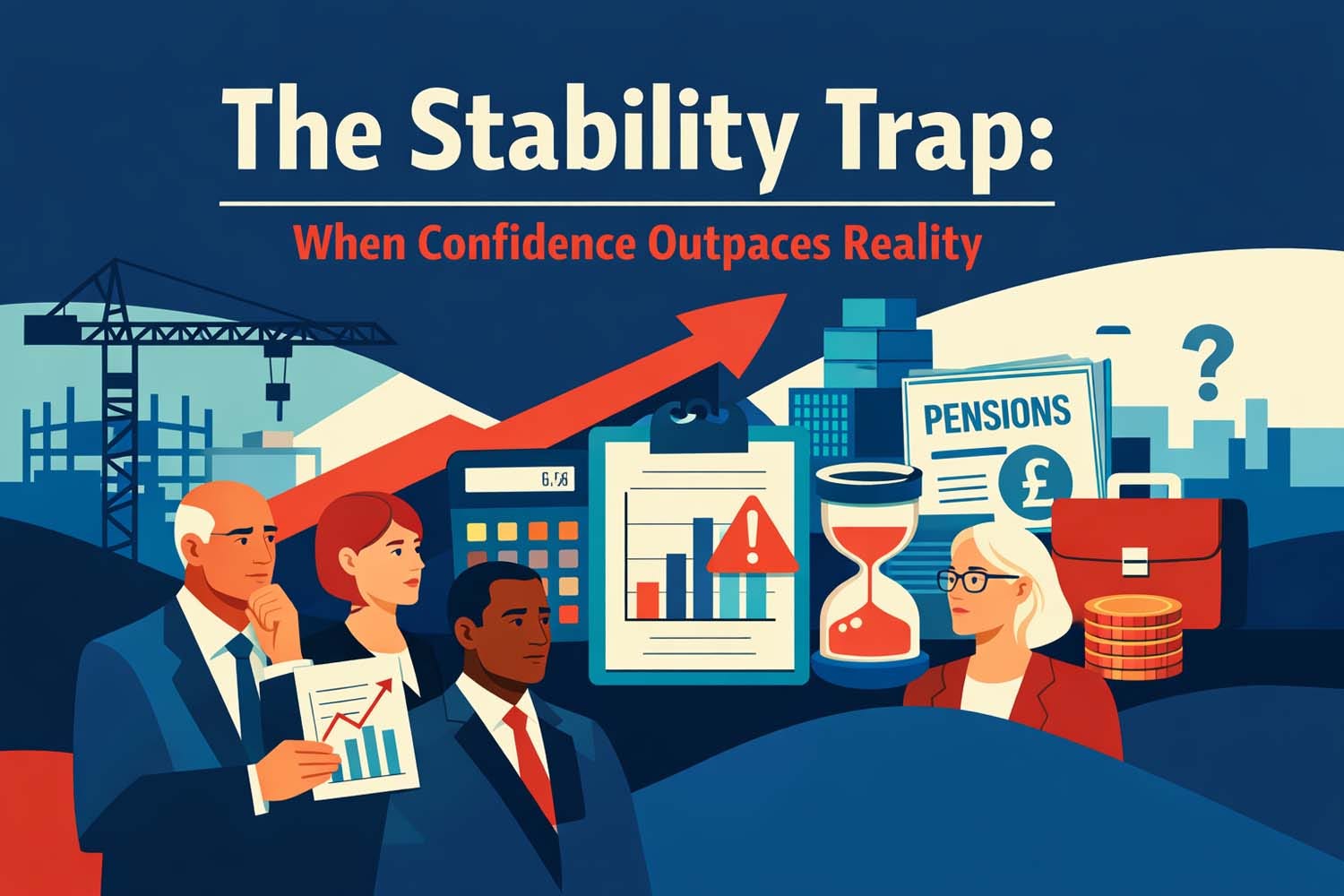
What the reader should watch for elsewhere is the emergence of a stable configuration in which growth must continue, confidence must be maintained, and contradiction must be managed rather than explored. Once that configuration forms, the system becomes resistant to correction because correction threatens multiple forms of legitimacy at once.
This lens is not about what Carillion should have done. It is about how systems like this behave under pressure, and why they often appear most confident shortly before they fail.
2. The System in One View
The system examined is the governance and financial control architecture of a large, listed outsourcing and construction group with deep exposure to long-term public sector contracts.
Formally, the system exists to deliver shareholder value through project execution, service delivery, and infrastructure development. It claims to balance growth, risk management, and stewardship obligations through board oversight, audit assurance, and market disclosure.
Functionally, the system was optimised to protect continuity of growth, market confidence, and access to capital. Dividend stability, earnings guidance, and contract pipeline visibility were treated as primary indicators of organisational health.
Key authority holders included the executive team as originators of strategy and financial narrative, the board as approver of strategy and assurance, the audit committee as guardian of reporting integrity, external auditors as validators of accounts, and government clients as indirect stabilisers through contract awards.
Boundary conditions were material. The organisation operated with thin margins, high working capital demands, and long-duration contracts. Credit ratings, covenant compliance, and supplier confidence were critical. Public sector dependence created an implicit expectation of continuity, while also increasing reputational sensitivity.
Dominant incentives were concentrated on revenue growth, earnings per share, and dividend maintenance. Executive remuneration and market valuation reinforced these priorities. Constraints operated in parallel. Disclosure of deterioration threatened credit access. Contract withdrawal threatened revenue visibility. Admission of structural weakness threatened investor confidence.
Information reaching the board was filtered through these incentives and constraints. Operational variance was translated into financial adjustments. Risk was discussed primarily in terms of mitigation rather than exposure. The system privileged explanations that preserved optionality and deferred recognition of loss.
The result was a governance machine that appeared orderly, compliant, and active, while being structurally inclined to defer confrontation with its own fragility.
3. Governing Logic and Constraints
Authority within the system was exercised through approval of narrative coherence rather than through ownership of underlying conditions. The board’s formal power was substantial, but its practical role was to validate management’s framing of performance and risk.
Information moved upward through layers designed to summarise and sanitise. Project-level uncertainty was aggregated. Forecasts were normalised. Adverse variance was explained as timing or execution noise. By the time issues reached board level, they were already contextualised as manageable.
Risk visibility was asymmetric. Risks that threatened short-term market confidence, such as covenant breaches or dividend interruption, were highly visible and actively managed. Risks that accumulated slowly, such as pension deficits, supplier stress, or contract margin erosion, were structurally less salient.
The system made certain actions easy. It was easy to pursue new contracts to replenish revenue. It was easy to use accounting judgement to smooth performance. It was easy to defer pension contributions. It was easy to rely on supplier financing.
Other actions were hard. It was hard to pause growth without triggering market reaction. It was hard to acknowledge systemic contract mispricing without impairing balance sheets. It was hard to rebase expectations without cascading consequences.
Some actions were effectively impossible. An abrupt shift to conservative recognition would have destabilised reported performance. A suspension of dividends would have signalled distress. A withdrawal from public contracts would have undermined the business model itself.
Within these constraints, rational actors optimised for survival within the reporting period rather than resilience across cycles. The system did not reward early recognition of loss. It rewarded maintenance of confidence.
4. Repeatable Dynamics
Growth as obligation
Once growth became the organising metric, it ceased to be a choice. Revenue expansion was required to service debt, sustain dividends, and justify prior strategy. Growth validated past decisions and funded present commitments.
Accounting as temporal risk transfer
Revenue recognition converted future uncertainty into present legitimacy. Losses were deferred, profits accelerated. This did not eliminate risk. It displaced it forward and outward, away from current decision-makers.
Assurance as substitution for scrutiny
Audit processes focused on compliance with standards rather than on business sustainability. Clean opinions reinforced confidence. The presence of review displaced the need for interrogation.
Board challenge without leverage
Non-executive directors could question assumptions, but lacked independent information channels. Challenge occurred within the same narrative frame it was meant to test. Dissent was procedural, not disruptive.
Dividend primacy
Dividend continuity became a proxy for health. Maintaining payouts constrained strategic options and absorbed cash that might otherwise have revealed underlying stress.
Risk displacement to the supply chain
Working capital pressure was exported to suppliers through extended terms. This preserved liquidity internally while increasing systemic fragility externally.
Public sector reliance as stabiliser
Ongoing contract awards signalled confidence and reduced urgency for correction. External validation reinforced internal belief that the model remained viable.
Each dynamic reinforced the others. Together they formed a closed loop in which the organisation appeared stable while its margin for error collapsed.
Conclusions: What This Pattern Produces
The mature form of this pattern is an organisation that looks compliant, confident, and well governed while becoming structurally brittle. Boards and executives often misread this state because the usual indicators remain positive until very late.
Effort is typically misdirected towards strengthening reporting, refining risk language, or increasing assurance activity. These actions increase surface order while leaving governing incentives untouched.
Correction is resisted because it requires simultaneous shifts in authority, incentives, and tolerance for uncertainty. Partial intervention often worsens the problem by adding reassurance without changing trajectory.
The Carillion pattern produces collapse not through sudden shock, but through loss of adaptive capacity. By the time recognition becomes unavoidable, options are already constrained.
What lingers is not a lesson, but a recognition. Systems that reward confidence, defer loss, and diffuse responsibility will behave this way again. They will appear robust until they are not.